


One would imagine a film entitled Elaine Stritch: Shoot Me would take the form of a full-on retrospective salute to a woman whose acerbic wit, “shoot from the hips” manner and dynamic performing style have made her a Broadway legend. But while celebrating her subject, director Cheiemi Karasawa doesn’t do it as an “Elaine’s Greatest hits” clips compendium. To be sure Stritch’s work with the vaunted likes of Noel Coward (Sail Away), Edward Albee (Who’s Afraid of Virginia Woolf), Alain Resnais (Providence) and Stephen Sondheim (Company) get copious mention. But Shoot Me isn’t really about Elaine Stritch’s past. . .save in passing. Rather it deals with what it means to be Stritch in the here and now. And, that here and now finds her at a crossroads not all that different from the one faced by any number of less famous senior citizens.
In her mid-eighties in the film (she is now eighty-nine), and far from the best of health due to Type 1 diabetes, Elaine Stritch has decided to “pack it in” as a performer and head home to Michigan, her family and well-deserved retirement. What’s fascinating is that being the very singular woman she is, she deals with all this without the slightest trace of sentiment or self-pity. Rather, she regards bringing down the curtain on her career (for that indeed is what the film features most dramatically) with a cool, clear and sometimes merciless eye. The star has experienced a lot both personally and professionally over the last six-and-a-half decades and wants her present situation to be shown as honestly as possible. And that sometimes means presenting herself at her most abject.

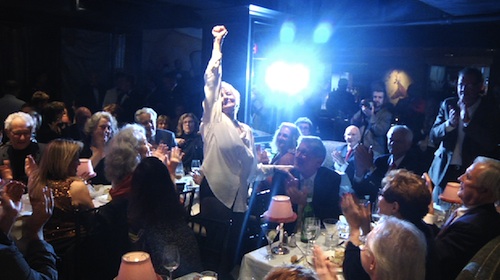
Filmed over a period of a year-and-a-half (February 2011 to July 2012), Shoot Me finds Stritch doing her final 30 Rock episode (she plays series star Alec Baldwin’s mother), and performing the last of her peerless cabaret shows at the Café Carlyle, along with a special Sondheim salute at Town Hall. We see her behind the scenes with fellow show business notables like Nathan Lane, Tina Fey and Alec Baldwin (who offer their own witty asides about her), choosing a room for a performance space to be dedicated to her at the Stella Adler Acting Studio (she prefers a small one to a large), singing an off-the-cuff acapella duet with the elevator operator at the Hotel Caryle (a moment of great casual conviviality), and more seriously we see her on stage forgetting the lyrics of songs she’s sung countless times. Consequently when she tells her patent and loving musical director Rob Bowman “When I forget your name the show’s over,” she’s not kidding.
 The show nearly is over at one point for director Karasawa when Stritch, whose blood sugar levels require constant monitoring, has an attack that puts her in the hospital; for a week. Karasawa and her camera crew are right there at Stritch’s bedside to film her pain-filled face. This is not an “invasion of privacy” in any way. For Stritch makes it clear that “warts and all” is the way she wants to be seen at all times. She does not ask for our sympathy. She only wants our attention. For Stritch believes that, as she enters her “last act,” she has much to say to in her last one as she did in the first two acts. What she has to impart never takes the form of moralizing lectures, or even offhand asides—though she has a lot of those of a more light-spirited nature. Rather it relates to the context she’s trying to create as a symbolic reflection on-screen of the world she lives in off-screen. Key in this regard is a moment when Stritch interrupts the shooting to tell the cinematographer where she wants the camera positioned to film her in her kitchenette as she takes a tray of English muffins out of a box and puts it away. These are “Bay Muffins”—the product produced by her late husband John Bay. Married from 1973 until his death from brain cancer in 1982, Bay was clearly the love of Stritch’s life. But she doesn’t talk about that. She wants this little private ritual to stand for it instead. Consequently this must be filmed up to her exacting standards.

As for romance in general, Stritch is delightfully wry when she recounts how she turned down a young pre-Jackie JFK, who was hoping to top off a pleasant evening out by going to bed with her. For while scarcely prudish, Stritch underlines that her Catholic convent education had made casual sex impossible for her at that point. She did go on to lose her virginity to actor Ben Gazzara, and most assuredly considered him a possible mate. But that was not in the cards. Underscoring this is actor James Gandolfini who amusingly notes that had they met in their thirties, he and Stritch would have had a “passionate affair” that would have ended badly. What they did have is a friendship that terminated with Gandolfini’s sudden death. But the film doesn’t linger on this sadness, nor any other sense of sadness that Stritch has encountered over the years. For Elaine Strich has done her share of mourning for those she has loved already, and she doesn’t want to revisit it now. What interests her, instead, is making preparations for “leaving the stage” in the most absolute way imaginable. Stritch is looking towards her own death without so much as blinking.
Elaine Stritch is quite secure about her professional career. She knows she has amassed enough achievements in theater, film and cabaret that she won’t be forgotten. But through this film what she wants us to remember is how Elaine Stritch faced life and death. And with the help of accompanist Rob Bowman and filmmaker Chiemi Karasawa she does so in the highest and grandest of style. Call it Umberto D: The Musical.
I think she’d like that.